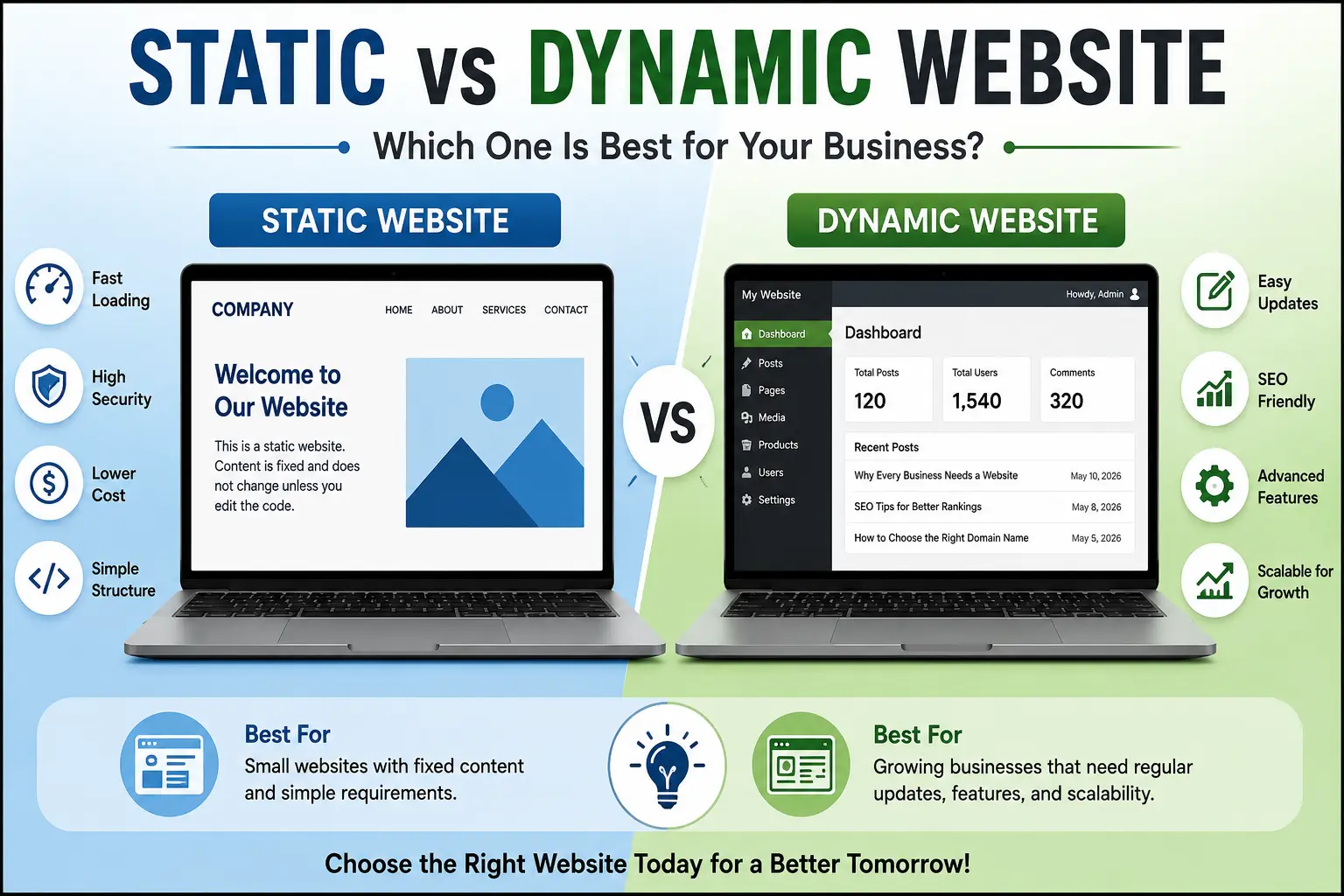
When planning a new website, one of the first questions many business owners face is whether they should choose a static website or a dynamic website. At first, both may look similar to visitors. Both can have a homepage, about page, service pages, images, contact forms, and a professional design. But behind the screen, they work in very different ways.
Choosing the right type of website is important because it affects your budget, performance, maintenance, SEO, future updates, and business growth. A small business that only needs a simple online presence may not require a complex dynamic website. At the same time, a growing company that needs regular content updates, blog posting, product management, or user login features may find a static website too limited.
In this guide, let us understand the difference between static and dynamic websites in simple language.
What Is a Static Website?
A static website is a website where the content is fixed and does not change automatically. Each page is usually created using HTML, CSS, and sometimes JavaScript. When a visitor opens a page, the same content is shown to everyone unless the developer manually edits the files.
For example, a five-page business website with Home, About, Services, Gallery, and Contact pages can be built as a static website. If the business owner wants to change a service description or add a new image, the developer has to edit the website code and upload the updated file again.
Static websites are simple, fast, and secure. They are suitable for businesses that do not need frequent updates.
What Is a Dynamic Website?
A dynamic website is a website where content can be updated easily through an admin panel or content management system. It usually uses a database to store information. Popular examples include WordPress websites, e-commerce websites, job portals, news portals, booking websites, and membership websites.
In a dynamic website, the owner can log in to the dashboard and add new pages, blog posts, products, job listings, images, or other content without touching the code. This makes dynamic websites more flexible for businesses that want to update content regularly.
Main Difference Between Static and Dynamic Websites
| Feature | Static Website | Dynamic Website |
|---|---|---|
| Content Updates | Manual code editing required | Can be updated from admin panel |
| Speed | Usually very fast | Depends on hosting and optimization |
| Cost | Usually lower | Usually higher |
| Best For | Small websites with fixed content | Blogs, portals, e-commerce, growing businesses |
| Maintenance | Low maintenance | Requires regular updates and security checks |
Benefits of a Static Website
1. Fast Loading Speed
Static websites load quickly because they do not need to fetch content from a database every time a visitor opens a page. Faster loading helps improve user experience and can also support better SEO performance.
2. Lower Development Cost
Static websites are generally more affordable because they require fewer backend features. For small businesses with limited requirements, this can be a budget-friendly option.
3. Better Security
Since static websites do not usually depend on databases, login systems, or complex backend functions, there are fewer security risks compared to dynamic websites.
4. Simple Hosting Requirements
A static website does not need heavy server resources. It can run smoothly on basic hosting plans, which helps reduce yearly maintenance costs.
Limitations of a Static Website
The biggest limitation of a static website is that content updates are not easy for non-technical users. If you want to add blogs, update services, upload new images, or change pricing often, you may need developer support every time.
Static websites are also not suitable for advanced features like user accounts, online payments, product management, booking systems, job applications, or dashboards.
Benefits of a Dynamic Website
1. Easy Content Management
A dynamic website allows business owners to manage content from an admin panel. You can add blog posts, edit service pages, upload images, update products, and publish announcements without depending on a developer for every small change.
2. Better for SEO Growth
If you want to publish regular blog posts and target more keywords, a dynamic website is more useful. WordPress and other CMS platforms make it easier to manage SEO titles, meta descriptions, categories, internal links, and content updates.
3. Suitable for Advanced Features
Dynamic websites can include features such as login systems, enquiry management, online payments, product filters, order tracking, resume uploads, appointment booking, and customer dashboards.
4. Scalable for Business Growth
As your business grows, a dynamic website can grow with it. You can add new sections, new services, blog categories, landing pages, integrations, and automation features.
Limitations of a Dynamic Website
Dynamic websites usually cost more than static websites because they require backend development, database setup, admin panel configuration, security planning, and regular maintenance.
They also need proper optimization. If a dynamic website is poorly built or hosted on a slow server, it may load slowly. Regular updates, backups, security checks, and plugin maintenance are also important.
Which Website Is Best for Small Businesses?
If your business only needs a simple online presence with basic information, a static website may be enough. For example, a small local shop, personal portfolio, event page, or basic company profile can work well as a static website.
But if your business wants to publish blogs, collect leads, manage services, upload projects, display products, or improve SEO through regular content, a dynamic website is the better choice.
Static Website Is Best For
- Small business profile websites
- Portfolio websites
- Landing pages
- Event websites
- Simple service websites
- Websites with rarely changing content
Dynamic Website Is Best For
- Business websites with admin panel
- Blogs and news websites
- E-commerce websites
- Job portals
- Real estate websites
- Educational websites
- Booking websites
- Membership platforms
Cost Difference Between Static and Dynamic Websites
A static website usually costs less because it has fewer technical requirements. A basic static website may be suitable for businesses that want a professional online identity without regular updates.
A dynamic website costs more because it includes content management, database support, admin panel, and advanced functionality. However, for long-term growth, the extra investment can be valuable because the business owner gets more control over the website.
SEO: Static vs Dynamic Website
Both static and dynamic websites can rank on Google if they are properly designed and optimized. SEO does not depend only on whether a website is static or dynamic. It depends on content quality, page speed, mobile friendliness, proper headings, internal links, schema, backlinks, and user experience.
However, dynamic websites are usually better for ongoing SEO because they make content publishing easier. If your goal is to bring traffic through blogs and service pages, a dynamic website gives more flexibility.
Final Verdict
The best choice depends on your business goals. If you need a simple, fast, low-cost website with fixed information, a static website is a good option. If you need regular updates, blog posting, SEO growth, product management, or advanced features, a dynamic website is the smarter choice.
For most growing businesses in 2026, a dynamic website offers better long-term value. But for small businesses with basic needs, a static website can still be a practical and affordable solution.
Before choosing, think about your future needs. A website should not only look good today; it should also support your business growth tomorrow.