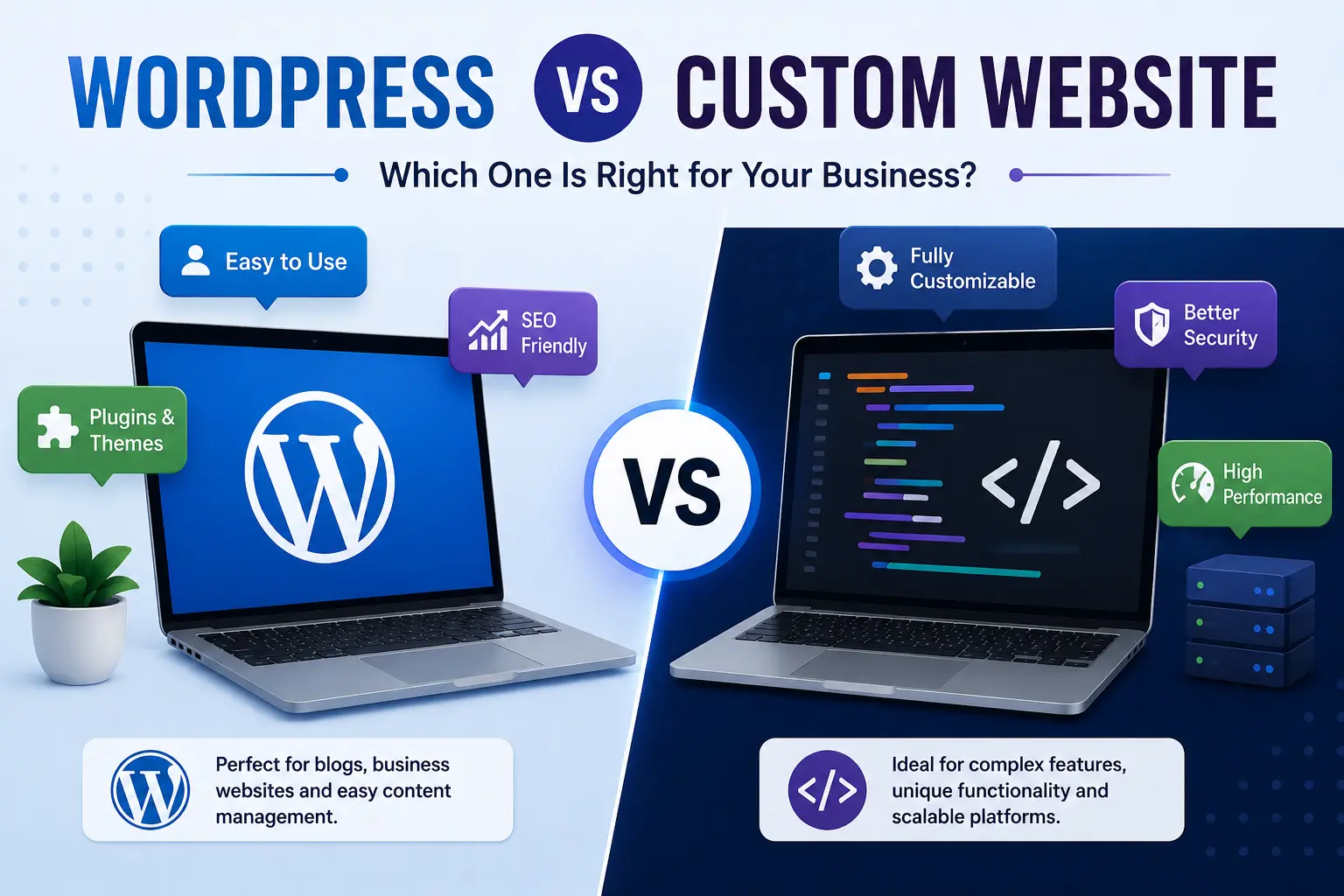
When a business decides to create a website, one common question comes first: should we build it using WordPress or go for a custom website? Both options can create a professional online presence, but they are not the same. The right choice depends on your budget, business goals, required features, future growth plans, and how much control you want over the website.
For many small and medium businesses, WordPress is a practical and affordable choice. For businesses that need unique features, advanced performance, special workflows, or complete flexibility, a custom website may be the better option. Before making a decision, it is important to understand how both work and where each one fits best.
If you are still confused about basic website types, you can also read our detailed guide on Static vs Dynamic Website to understand the foundation before choosing WordPress or custom development.
What Is a WordPress Website?
WordPress is one of the most popular content management systems used to build websites. It allows website owners to manage pages, blog posts, images, menus, products, and basic settings from an easy dashboard. You do not need to edit code every time you want to update content.
A WordPress website can be built using ready-made themes, custom themes, page builders, and plugins. This makes it flexible for many types of websites such as business websites, blogs, portfolios, news websites, educational websites, and even e-commerce stores using WooCommerce.
The biggest advantage of WordPress is that it gives business owners more control over content. After the website is developed, they can publish blogs, edit service pages, add images, and manage basic SEO settings without always depending on a developer.
What Is a Custom Website?
A custom website is built from scratch based on the exact requirements of a business. Instead of using a ready-made system, developers create the design, frontend, backend, database, admin panel, and features according to the project needs.
Custom websites are usually preferred when a business needs something unique that cannot be handled properly using standard WordPress plugins or themes. Examples include job portals, SaaS platforms, custom dashboards, booking systems, CRM solutions, advanced marketplaces, learning platforms, and business automation tools.
A custom website gives more freedom, but it also requires more planning, development time, testing, and budget.
WordPress vs Custom Website: Main Differences
| Feature | WordPress Website | Custom Website |
|---|---|---|
| Development Time | Faster to build | Takes more time |
| Cost | Usually more affordable | Usually more expensive |
| Content Management | Easy dashboard available | Admin panel must be custom-built |
| Design Flexibility | Good flexibility with themes/builders | Complete design freedom |
| Scalability | Good for most business websites | Better for complex platforms |
| Maintenance | Requires plugin/theme updates | Requires developer-level maintenance |
Benefits of WordPress Websites
1. Affordable for Small Businesses
WordPress is usually cost-effective because the basic structure, dashboard, themes, and plugins are already available. This reduces development time and makes it suitable for startups, local businesses, consultants, agencies, and service providers.
2. Easy Content Updates
One of the biggest reasons businesses choose WordPress is content control. You can add blogs, update text, upload images, edit pages, and manage basic website content through the admin dashboard.
3. SEO Friendly Structure
WordPress supports SEO-friendly URLs, headings, categories, tags, image alt text, meta titles, and meta descriptions. With proper setup, plugins like Yoast SEO or Rank Math can help manage on-page SEO more easily.
4. Large Plugin Ecosystem
WordPress has plugins for contact forms, SEO, caching, security, backups, galleries, analytics, WhatsApp chat, e-commerce, and many other features. This helps businesses add functionality without building everything from zero.
5. Faster Launch
If you need a website quickly, WordPress can be a good option. A basic business website or blog can be launched faster compared to a fully custom-coded website.
Limitations of WordPress Websites
WordPress is powerful, but it is not perfect for every project. Too many plugins can slow down the website or create compatibility issues. Poorly coded themes can affect speed, security, and user experience. Regular updates are also important to keep the site safe.
For highly customized systems, WordPress may become difficult to manage. If your project needs very specific business logic, complex dashboards, advanced search, high-level automation, or unique workflows, a custom website may be more reliable.
Benefits of Custom Websites
1. Built Exactly for Your Business
A custom website is designed and developed according to your exact needs. You are not limited by theme layouts or plugin restrictions. Every page, feature, workflow, and user journey can be planned specifically for your business.
2. Better Control Over Performance
Custom websites can be optimized for speed and performance from the beginning. Since only required features are developed, there is less unnecessary code compared to some plugin-heavy websites.
3. Advanced Features and Workflows
Custom development is suitable for projects that need complex features such as user dashboards, role-based access, custom search filters, payment systems, API integrations, report generation, CRM tools, and automation.
4. Strong Scalability
If your website is expected to grow into a large platform, custom development can offer better long-term scalability. It allows developers to structure the system based on traffic, data size, and future feature expansion.
5. Unique Brand Experience
Custom websites allow complete creative freedom. The design can be made fully unique to match your brand identity, customer journey, and conversion goals.
Limitations of Custom Websites
The main limitation of custom websites is cost. Since everything is planned and built according to specific requirements, development usually takes more time and budget. Even simple changes may need developer support if the admin panel is not designed properly.
Custom websites also require proper documentation, testing, security planning, and long-term technical support. Choosing the right development team is very important.
Which One Is Better for SEO?
Both WordPress and custom websites can perform well in SEO when developed correctly. WordPress makes SEO management easier for business owners because of plugins and content publishing tools. It is especially useful for blogs, service pages, and regular content marketing.
A custom website can also be excellent for SEO if developers follow best practices such as clean code, fast loading speed, mobile-friendly design, structured data, proper headings, optimized URLs, and strong technical SEO.
In simple terms, WordPress is easier for ongoing SEO content management, while custom websites provide more technical control when built by an experienced team.
Which One Is Best for Your Business?
Choose WordPress if you need a business website, blog, portfolio, company profile, landing page, news website, or small e-commerce store. It is a smart choice when you want affordability, fast launch, easy updates, and SEO content publishing.
Choose a custom website if your business needs a unique platform, advanced dashboard, custom user roles, special workflow, large-scale system, or features that cannot be handled properly with WordPress plugins.
Final Thoughts
There is no single answer for every business. WordPress is best for businesses that need a professional, manageable, and affordable website. A custom website is best for businesses that need full flexibility, advanced features, and long-term scalability.
Before choosing, think about your current needs and future plans. A good website should not only look professional today; it should also support your business growth tomorrow. If your goal is content, SEO, and quick launch, WordPress is a strong choice. If your goal is a unique system with complex functionality, custom development is the better investment.
About Me
My name is Shajudheen, and I am the founder of WebQuik. I help businesses create professional websites, improve their online presence, and use digital tools to grow faster.
I started WebQuik with a clear goal: to make website development simple, affordable, and useful for small businesses, startups, and service providers. My focus is not just on creating attractive websites, but also on building websites that are fast, mobile-friendly, SEO-ready, and easy to manage.
Through WebQuik, I provide website development, WordPress design, SEO-friendly website setup, digital marketing support, and custom web solutions based on each business requirement.